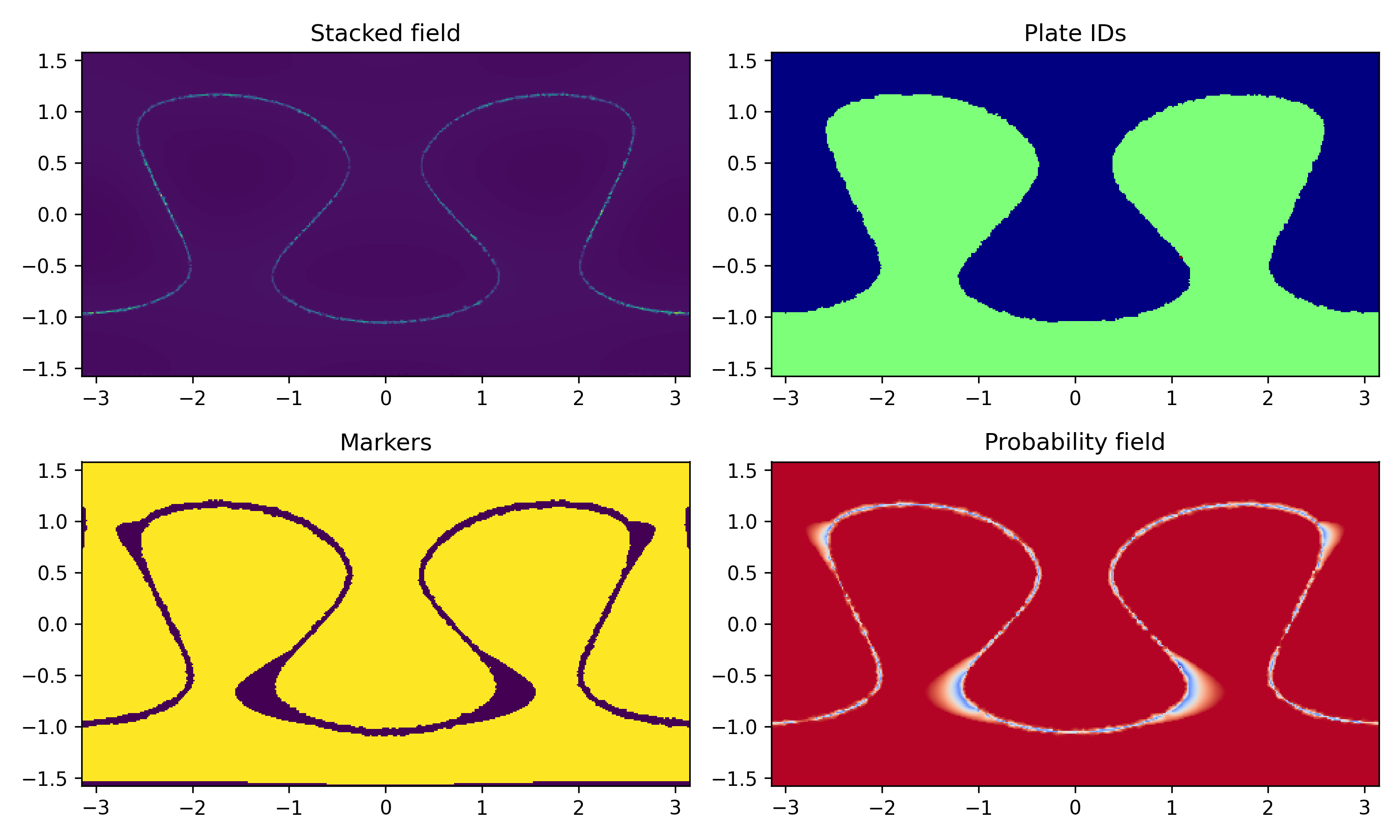
Basic Usage
Help function
It is recommended to access the most up-to-date information by either calling
help(example_function) or running ?example_function on a jupyter notebook.
As a demonstration, assuming a given input_xs, input_ys, input_zs, and
input_field (all numpy arrays), using platerecipy is as simple as follows:
 1
 2
 3
 4
 5
 6
 7
 8
 9
10
11
12
13
14
15
16
17
18
19
20
21
22
23
24
25
26
27
28
29
30
31 | from platerecipy.model import PlateModel
from platerecipy.grid import SphericalGrid
input_xs = # to be specified ...
input_ys = # to be specified ...
input_zs = # to be specified ...
input_field = # to be specified ...
# generating a consistent grid for interpolation
grid = SphericalGrid(input_xs, input_ys, input_zs)
# interpolating an input field
field = grid.interpolate_field(input_field)
# initializing a plate model
m = PlateModel(grid)
# stacking the interpolated field
m.stack_field(field)
# finding plates on the stacked field
m.find_plates(
boundary_quantile = 0.9, # threshold for the boundaries
separation_tolerance = 4*3.1416/180., # 4 degrees for separation tolerance
RW_beta = 200, # RW beta (for feature sharpness)
min_marker_size = 100 # to filter out micro plates
)
# outputting as a ParaView readable .vtk file
from platerecipy import io
io.save_as_vtk(m)
|
Additional examples